
As a custom home builder, my design opinions exist in a state like Schrödinger’s cat; I both do and do not have an opinion about what our clients love. The exception is for doors. While counters, tile, and fixtures usually steal the spotlight, doors send a message about a building’s soul, one you don’t notice you’re reading. I think they matter more than we realize and deserve a higher priority than they’re often given. Here is why you might want to pay a little more attention to doors, and why the very story of passage is worth a closer look.
The part of the house you touch the most
Before I try to persuade you, I’ll offer a few admissions. I am what you might call a kinesthetic learner and life experiencer. How things feel is impactful to me. I notice sound and visuals, but I’m colorblind for Pete’s sake, so I miss most of what you all see visually. But how a knob turns, or the weight of a thing in your hand, can be either troubling or deeply satisfying. I abhor cheap tools, clunky mechanisms of all kinds, poor machining, mislocated textures, things that have no sense of weight in your hand. So how a door feels when it opens and closes speaks volumes to me.
I’ll dive into the craft bit of this shortly, but let’s start with an important perception related to doors. In all forms, doors signify a location change. They show us how to enter or leave a space, how to close it off, where privacy is possible, and where it can be lost. The cheapest and flimsiest of doors can essentially resolve all of the above, but the signal in how they’re made is my larger point.
The story of passage can be meaningfully and constantly altered by the doors in a building. They’re much less about first impressions, though they give one. What endures are the perpetual impressions. They are a constant, daily piece of user experience in homes. Consider first the difference between a door that slams shut loudly and one that closes with a subtle, resonant click. Imagine one that rattles no matter how carefully you operate it versus one with weight and substance that adds refinement to your sensory experience as you open, swing, and move through it. It makes a difference, and you will notice it every time you use that door.
Every door is a sentence
The visual part of doors can also be powerful indicators of intent, quality, and forethought. Whether ornate or formal, hidden in wall material, or intentionally painted a loud color, messages abound. Round the top, and you might find whimsy; fade into the wall, and you might tilt towards corporate formality; bright colors and artistic influence could easily tell the story of the home’s culture and occupants. I’m genuinely curious what would happen if we put primer gray commercial metal doors inside an otherwise ornate and highly architecturally defined building. What story could we tell? Could we encourage or discourage movement in a building? Could we signify public, private, or utility spaces? What if we intentionally de-emphasized the door’s visual impact to prioritize everything else?
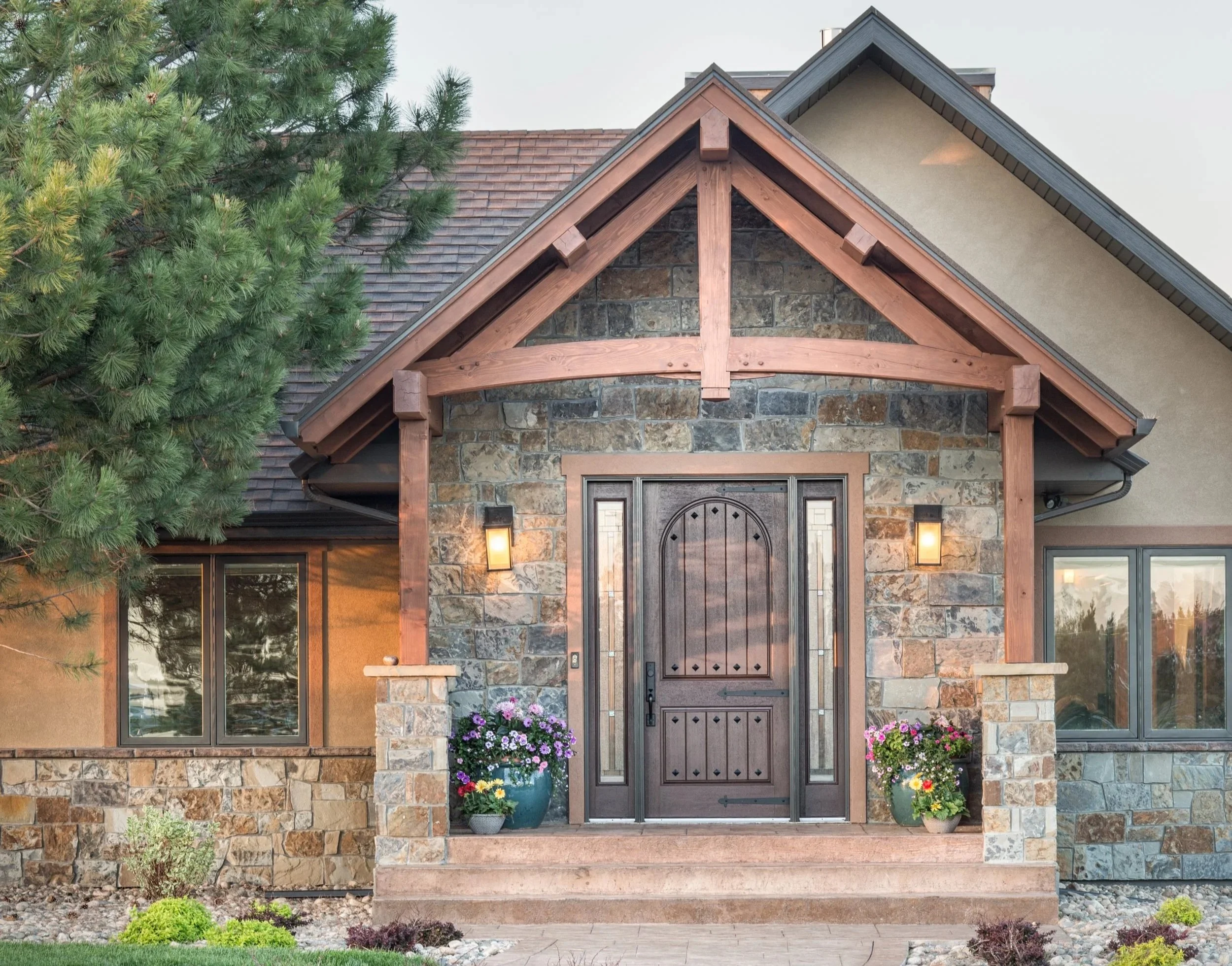
What’s actually inside a door
And we haven’t even gotten to the craft-and-feel part yet. Let me give you an incomplete primer on how most doors in houses are made.
First, thickness. Common doors in homes are 1 3/8” thick. No amount of craft I’ve ever seen will make a door that thick feel solid. It’ll rattle, it’s more likely to warp, and it really should stay under 6’-8” tall. A good door starts at 1 ¾” thick. At this thickness, it has a fighting chance of feeling right, closing well, and holding up over time.
Then there’s what’s inside, the part you feel every single time you use the door. In the thinner range, a few construction methods exist. There’s hollow core, solid Masonite or similar paint grade, and solid wood. Solid wood doors are probably made of a laminated stile and rail for stability. Stiles are the full-length vertical pieces on the edges. Rails are the horizontal pieces top, bottom, and middle. Door factories pump them out by the thousands, and they get brokered to local door shops that pre-hang them in jambs and ship them off to site. Their primary (and only) advantage is low cost.
Move to 1 ¾” and the cheaper methods largely disappear. Now they’re all made of a composite stile and rail, and the core is an engineered material that’s strong and stable. We laminate solid wood onto that stable core, which is far preferable, or in some cases a paintable composite like medium-density fiberboard (MDF). MDF paints well but wears poorly. Dings, nicks and scratches show up soon, and not in a charming patina kind of way. We can and do use MDF for the panels. Its stability is an advantage, and the bumps and bruises of daily use don’t usually hit the middle of the door. It helps control cost without having to accept a frustrating tradeoff.
Chances are the doors you’re most used to seeing are some version of the classic frame-and-panel. Doors with one to six panels are readily available, each carrying a slightly different style. The construction is born out of a practical need for stability, and we’ve spent centuries rearranging the panels to tell different stories. The look is so iconic that even the cheapest hollow-core doors are molded to fake it.
Now and then you’ll also see a slab door. No frame around the outside, just a monolith of some material. Primer gray metal in commercial interiors, plastic in residential, exquisite paneling on the high end. For premium doors, the paneling usually covers a stable core you never see. For most budget doors, the skin you see likely covers a laughable cardboard honeycomb, also known as hollow core.
Why any of this matters
There’s no test at the end of this, so you don’t need to remember stiles from rails. What I hope stays with you is the smaller thing underneath: every one of those choices, thickness, what’s inside, what the outside is made of, turns up in your hand and your ear a dozen times a day for as long as you live in the house. That’s the perpetual impression I was getting at. A door isn’t something you look at once. It’s something you operate.
Ultimately, this has been a rapid tour of a surprisingly deep craft. I’ve touched so briefly on every subject here that you might feel as confused as informed. My intent here is less a dissertation to a conclusion and more a nudge to your awareness. If reading this today leads you to notice doors a little more, I’ll be happy. And as for Schrödinger’s cat? Whether it's alive or dead on the other side, I just hope you don't have to open a cheap, rattling, hollow-core door to find out.