
A Thoughtful Way to Look at Your New Home Budget
Most people start the custom home journey with a simple, honest question: “What does it cost per square foot to build?”
It’s a reasonable place to begin. But to build a home that fits both your life and your budget, it helps to see that cost per square foot is just one of our big forces shaping the investment.
Square footage: a crude but useful tool
Cost per square foot is the language of real estate listings and some online calculators. It can offer quick comparisons, and it may help you understand whether your ideas are in the right ballpark.
If you sit down with a builder or architect who understands both your goals and the local market, they can usually provide a reasonable cost-per-square-foot range for your project. That’s often enough to answer the first—and most basic—question: Is what we want to build generally feasible?
But that’s about as far as this tool can take you. Cost per square foot can’t tell you what your home will actually cost, nor can it account for how choices about site conditions, structure, finishes, or the way decisions are made will shape the final number. To answer those questions, you need more precise tools.
Economies of scale
The second lens is overall size: not just “how many square feet,” but the overall size.
Homes under about 2,500 square feet have a relatively high percentage of fixed costs. There is one front door, one kitchen, one mechanical system, one driveway connection, one project manager. Those items don’t shrink or go away if the home gets smaller. A 1,600 square foot house and a 2,500 square foot house both need a front door; that cost is fixed. Overall reduction in cost to go below 2,500 square feet is often frustratingly small.
Between roughly 2,500 and 5,500 square feet, economies of scale become a benefit. Those same fixed elements we mention above get spread over more area. The front door that is “expensive” on a small home suddenly costs half as much per square foot when you double the size. Many homes of this size see cost per square foot decrease as they grow. They tend to add simpler space—bedrooms, halls, bonus areas—to a core that’s already paid for.
Above a certain point, cost per square foot often climb again. Extra kitchens, a second primary suite, significantly expanded garages, specialized rooms, and more complex structures start to behave less like “simple space” and more like new fixed costs of their own.
So square footage matters, but overall size—and where you are on this curve—matters too.
Eight big cost drivers
Layered on top of size are eight factors that can push a budget up or down even when the floor plan stays the same:
• Difficult site work
• Garages, both size and level of finish
• Masonry
• Glazing (glass and big door systems)
• Geographic location
• Covered/finished exterior space
• Interior finishes and fixtures-custom vs. readily available
• Exposed structure-Timber Framing and Steel
A relatively simple home on a flat, in‑town lot, with a 2-car garage, standard windows, and straightforward finishes will live at one end of the spectrum.
The same square footage, moved to a steep or remote site, with expanded garages, lots of stonework, large glass walls and folding doors, generous covered outdoor rooms, exuberant finishes, and exposed timber structure, will land on the other end of the spectrum. This list of 8 factors override cost/sq. foot.
In future letters, we’ll spend more time on these 8 factors: more detail about what they are and why they matter. Understanding them can help you choose where to invest and where to keep things simple.
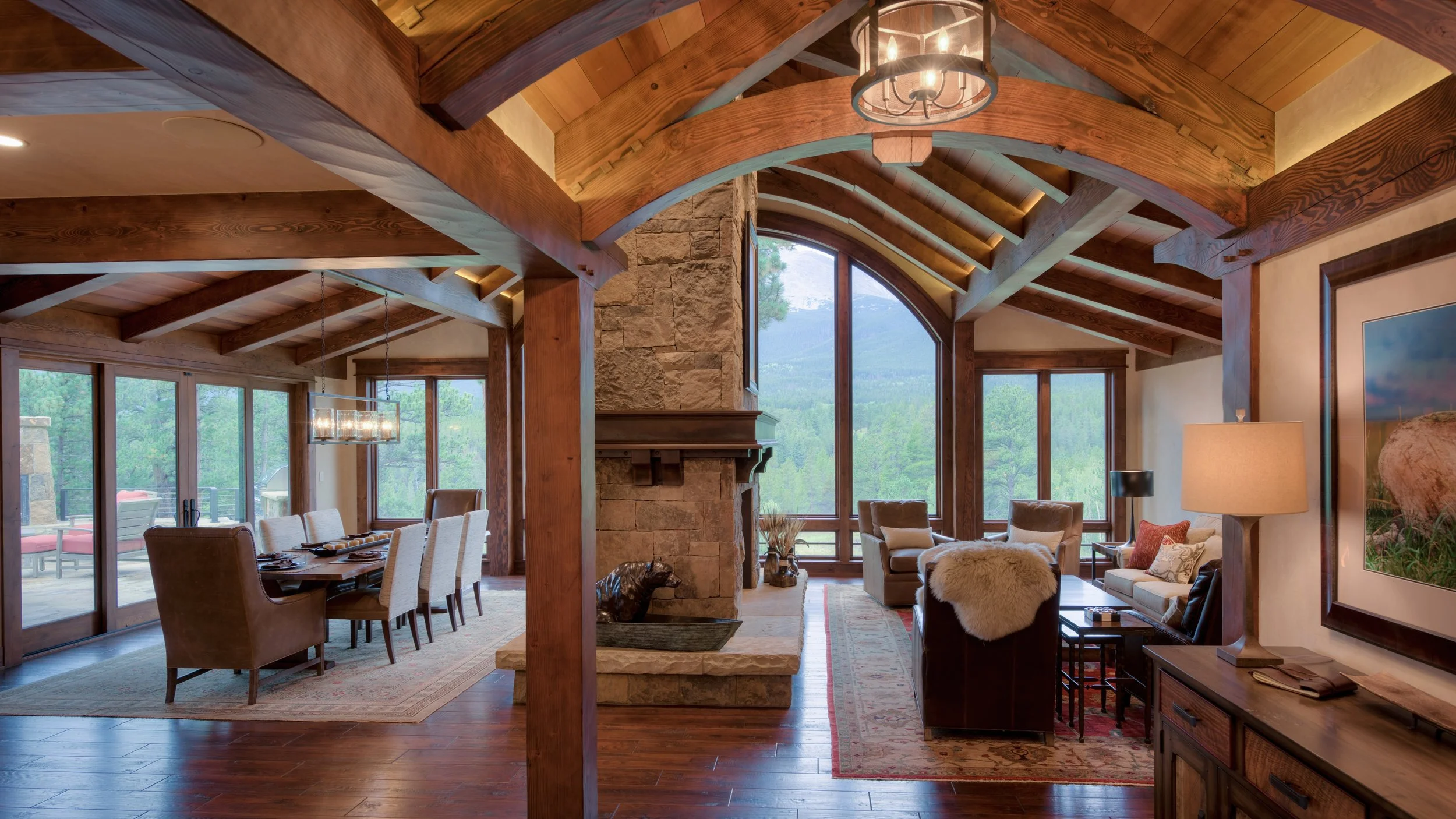
Two homes with the same floor plan can have very different costs if one uses exposed timber framing.
How decisions are made
The last factor is less obvious but incredibly powerful: how design decisions are made.
At one end of the spectrum, you ask your builder and design team to select systems and materials that fit a clear description and a firm budget. You tell us what you value most—like durability, low maintenance, or a certain look—and we assemble a coordinated set of choices that meet those goals inside the financial frame. Your inputs are mostly program and general style preference.
At the other end, owners want to be part of choosing almost everything. Not just “white countertops,” but which specific white from dozens of options. Not just “a black window,” but a particular profile, hardware, and brand. Not just “a stone fireplace,” but a carefully curated blend of stones, sizes, and patterns.
Both approaches, and all points in between, work. They do not cost the same.
The more decisions you want to be involved in, the more design time, iterations, sample rounds, and coordination the project will need. Owners often assume that if they pick from widely available products, they are staying economical. Sometimes that’s true. Just as often, it’s the act of deciding—slowing down to explore every option, pushing beyond standard packages—that adds cost, even when the materials themselves are not exotic.
A simple example: there might be fifty “white” countertops on the market. If you’re comfortable with us choosing from a curated few that meet the budget and work with the overall design, we can keep decision time and cost in check. If you want to see and consider all fifty, we will gladly guide that process—but expect it to cost more.
Putting the factors together
Looking at a custom home budget through these lenses—square footage, economies of scale, the eight major cost drivers, and how decisions are made—brings much-needed clarity and specificity to what your home will actually cost. More importantly, it shifts the conversation away from “How much is the builder going to charge us?” and toward a far more productive question: “What matters most to us, and how do we align our design and our budget so they work together?”
In the coming months, we’ll unpack these themes in more detail. Our goal is not to turn you into an estimator, but to give you enough clarity and language that you feel informed, confident, and well‑partnered as you shape one of the largest investments of your life.