
Where program and experience meet every day
Imagine working from a home office that truly supports you—quiet when you need it, connected when you want it, and calm enough that you can close the door and feel your shoulders drop.
For many of our design clients, a home office is a must-have. It carries as much weight in daily life as the kitchen or primary bedroom and deserves the same design attention.
Home offices are a clear example of considering both program and experience. Program asks: What has to happen here? Do you take calls all day, write in long stretches, meet clients on video, store files, spread out drawings? Experience asks: How do you want to feel while you do those things—focused, private, grounded, inspired?
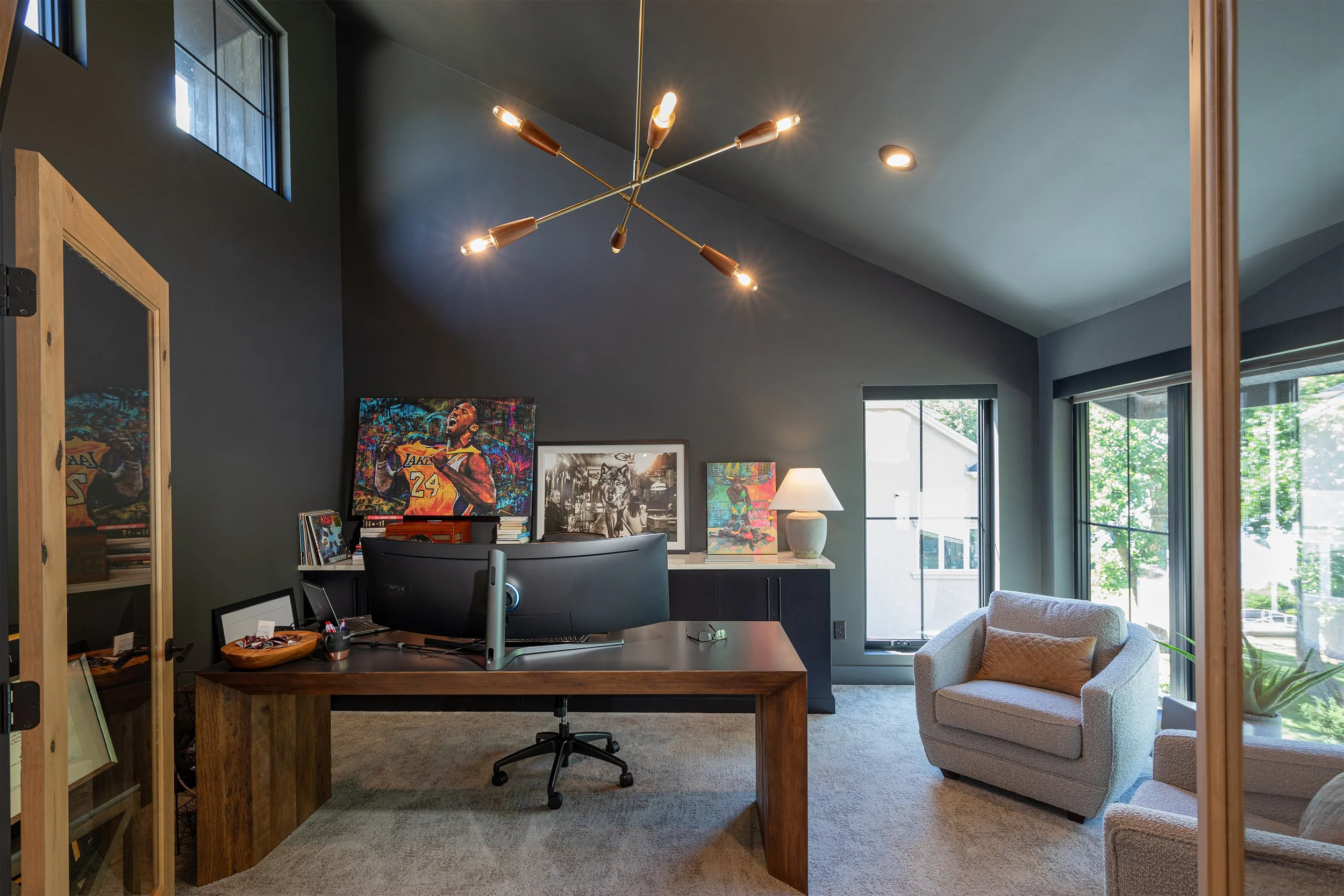
When function and feeling line up, a home office becomes more than a workspace; it becomes a place you actually like to be.
Location, location, location
Location is often the first design decision. An office near the kitchen may be convenient, but not if sound and traffic create constant interruptions. Sometimes the best office is a half-flight away, with a solid door, better sound privacy, and a view to the outside.
Natural light, views, and sound
Light and sound can shape your day as much as furniture. Natural light tends to support mood and focus, but can glare across a screen. A window behind the camera may be perfect for video calls; a window beside the desk may be better for writing or deep work. For almost all design programs, office users need control of light as time of day and task change. Sound, meanwhile, is its own design problem: insulation, door type, floor finishes all contribute. In many cases, we design near-full sound isolation—closer to a small recording studio than a typical bedroom—especially when confidential conversations are part of the workday.
Everything changes
We also think about how an office might evolve over time. A well-designed home office can do double duty as a guest room, studio, or quiet retreat when needed, without feeling like a compromise in any of those roles. With the right layout, storage, and furniture choices, the space can adapt as your work evolves, kids grow up or move out, or new projects enter your life.
Thoughtful design of a home office can reduce career stress, improve productivity, and make it easier to maintain balance between work and home life—especially when the commute is just a staircase or a hallway.
As always, thank you for letting us be part of your thinking about home and work. If you’re wrestling with how or where a home office should fit into your next project, I’m glad to talk.